Princess Ghida / KHCF: Cancer Advocacy Web Platform
Contributed to the public-facing awareness and fundraising site for Princess Ghida Talal, Chairperson of the King Hussein Cancer Foundation in Jordan.
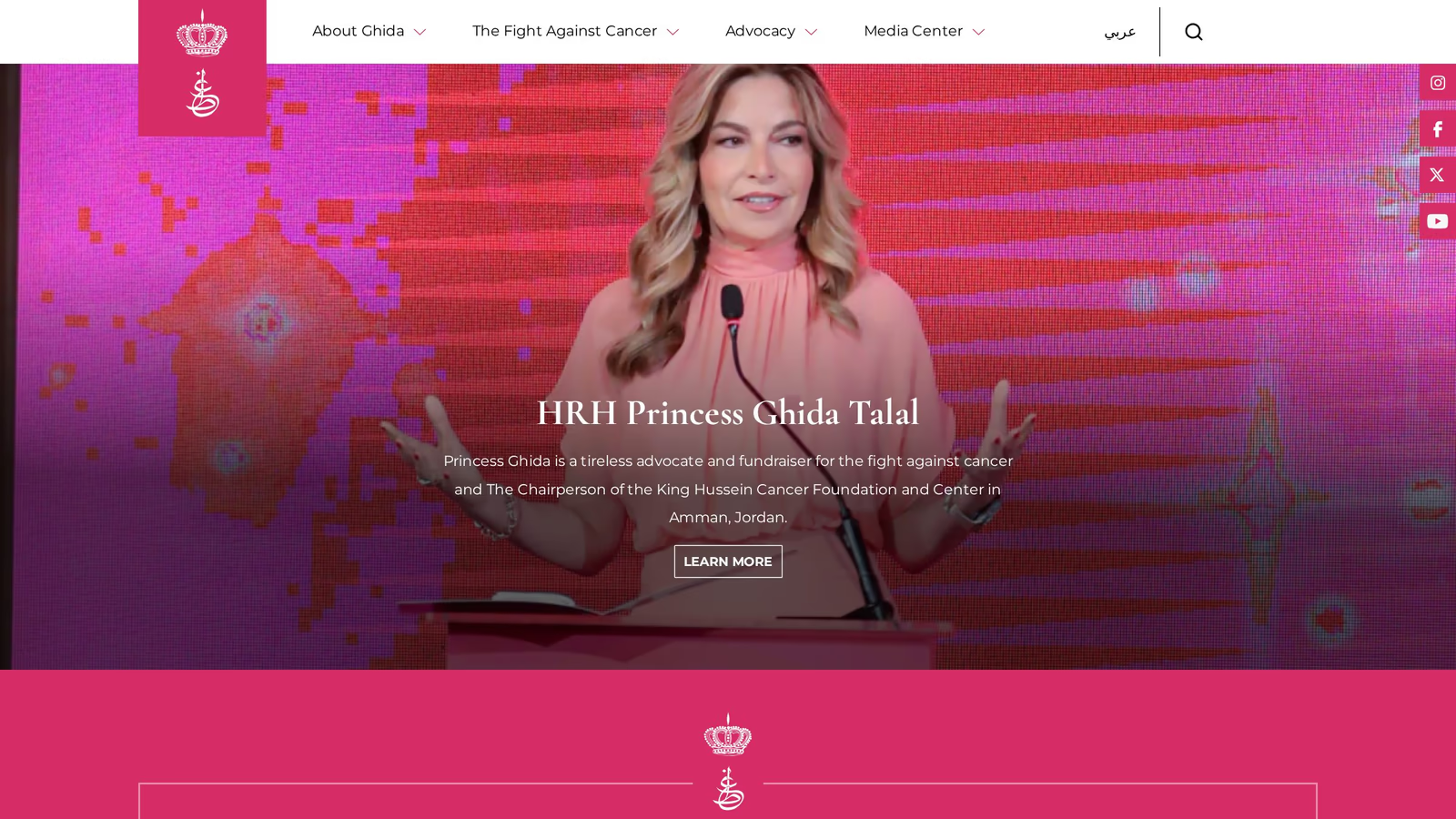
Not every project is a distributed system migration. Some of the most consequential work I’ve done involved making sure the right words, numbers, and donation buttons were on the right page and working correctly for one of the most significant cancer foundations in the Arab world.
The King Hussein Cancer Foundation - and its clinical arm, King Hussein Cancer Centre - is the institution that gives Jordan’s cancer patients a fighting chance. KHCF funds research, patient support, and advocacy across a region where the funding landscape for cancer care is thin. Princess Ghida Talal, as Chairperson, is the public face of that mission. The website at princessghida.jo is where that public face meets the world: international donors, advocacy partners, media, and patients’ families looking for information.
Context: KHCF is where I already knew the stakes
I had already done deeper technical work in this ecosystem. The HL7 integration at King Hussein Cancer Centre - connecting clinical systems for patient data exchange - was a separate project (see the KHCC case study). That work made clear what KHCF was dealing with at the clinical level: the volume of patients, the complexity of the treatment coordination, the weight of the institution.
Coming in to contribute to the public-facing site wasn’t glamorous. It was correct. The foundation’s public presence needed to be reliable, well-maintained, and accurate, and those things don’t happen by accident.
What the work actually involved
A public awareness and fundraising site for a foundation of this profile carries requirements that aren’t immediately obvious from the outside.
Content accuracy matters in ways it doesn’t for most commercial projects. When a foundation is describing the scope of cancer research it funds, the patient statistics it cites, or the programs it operates, those numbers are public commitments. Getting them wrong - even a stale figure from a previous annual report - has reputational consequences that no amount of “sorry, the website was out of date” can fully repair. The CMS workflows needed to support non-technical staff maintaining content with enough guardrails to catch obvious errors before publication.
Multilingual reach matters. KHCF operates in a region where Arabic is primary for domestic audiences and English is primary for international donor outreach. The site needed to handle both, with content parity across languages and right-to-left layout correctness. Arabic web rendering in 2019 was less reliable than it is today. Getting bidirectional layout right across content types required attention that a monolingual project doesn’t.
Donation flows need to be trustworthy. A visitor arriving at a cancer foundation’s site to donate is in a high-stakes emotional state. If the donation flow looks uncertain, breaks on mobile, or generates ambiguous confirmation - you’ve lost a donor who may not come back. This is a category where “it mostly works” is not a success criterion.
What I contributed
My role here was contributor rather than lead - I was part of a team working on the site, not the architect of its infrastructure. The work involved:
- CMS implementation and content modeling for structured publication workflows
- Frontend markup and styling, including RTL layout correctness for Arabic content
- Integration and reliability work on the donation and contact flows
- Cross-browser and cross-device testing for an audience whose device profile was diverse
Why I include this
Because not all valuable work announces itself with a latency reduction metric.
The KHCF mission is real and the stakes are real and making sure a fundraising site worked correctly for people trying to support cancer patients in Jordan was worth doing well. It didn’t require Camunda or Keycloak or a Kafka topic. It required care and attention to get the details right for an audience that deserved both.
Engineers who only count their résumé lines by stack complexity are leaving out half the picture.